lonk.indah.link
LARAMIE, Wyo. – The Colorado State volleyball fell behind early in the second edition of the Border War and fought to have a chance to push the match to a fifth frame, but couldn't secure the fourth set dropping the match, 3-1.
The Rams dropped the first two sets, 27-25, 25-19 to fall behind early in the match. CSU responded late in the third set as it was behind 22-15. The Rams finished the frame on a 10-1 run to grab the win and avoid the sweep. In the fifth, it was a back-and-forth affair, with long runs from both teams. The Rams led at 15-10 before the Cowgirls used a 4-0 later on to get within two points at 17-15. CSU continued to lead at 20-17 before Wyoming finished the match on a 8-2 run, including scoring the last six points.
"I think it was evident that Wyoming was going to hit more aggressively and they played better defense," head coach Tom Hilbert said. "There was a key point in the end of the first set where we made some mistakes and that set the tone, because they came back and beat us in set one. Our team played hard. I have to give it to them, but Wyoming made more plays than we did. We had a nice comeback in the third set, we were ahead in the fourth and then Wyoming came back. There were a lot of point swings and lead swing that created momentum in the match."
STAT OF THE MATCH
There were 30 tie scores and 13 lead changes in the match.
NOTES
- Breana Runnels found the floor for 18 kills on 57 swings to lead the Rams
- Sasha Colombo added 11 kills while hitting .304
- Ciera Zimmerman dished out 43 assists and picked up six digs
- Alexa Roumeliotis led the back row with 29 digs
- Both Alyssa Bert and Brooke Hudson added double-figure digs with 12 and 10, respectfully
- The Rams were out blocked 14-9 and out hit, .237 to .157
UP NEXT
Colorado State will have next weekend off before heading to San Jose State for two matches, March 12 and 13.
"short" - Google News
February 28, 2021 at 12:19PM
https://ift.tt/3kxz0Xn
Rams' Comeback Falls Short - CSURams.com
"short" - Google News
https://ift.tt/2SLaFAJ
Sunday, February 28, 2021

What Is Time? - ScienceAlert
lonk.indah.link
"time" - Google News
February 28, 2021 at 04:32AM
https://ift.tt/3ktfWts
What Is Time? - ScienceAlert
"time" - Google News
https://ift.tt/3f5iuuC
Time is a measure of non-stop, consistent change in our surroundings, usually from a specific viewpoint.
While the concept of time is self-evident and intuitive – the steady passing of events before our eyes; the orbit of the Moon around our planet – describing its fundamental nature is much harder.
Even physicists aren't sure what actually happens when time passes. Although they do have a few hypotheses.
How does time work?
For centuries, time was regarded as a constant, independent force, as if the Universe's progress is governed by a single clock.
This description of time changed in 1905 with Albert Einstein's theory of special relativity.
While the passing of time was already known to be closely connected to space, this monumental theory was the first to combine space and time into a single field, one with measurements that vary depending on the relative motion or gravitational forces of objects within it.
Basically, that means time is relative.
Is time real?
Two people moving at the same velocity will each agree their measures of distance and time match. As one person changes speed, however, they will see the other's measure of time and distance change, even as their own stays the same.
Without any reason to prioritize one perspective of time over another, this means time isn't a constant universal unit at all. It is a relative measurement that varies as objects move faster or slower, or as they're subjected to more or less gravity.
Gravity curves space and time: The stronger the gravity, the more it curves space-time, and the more time slows down.
You can see an example of this in the image below, which shows Earth's mass curving space-time.
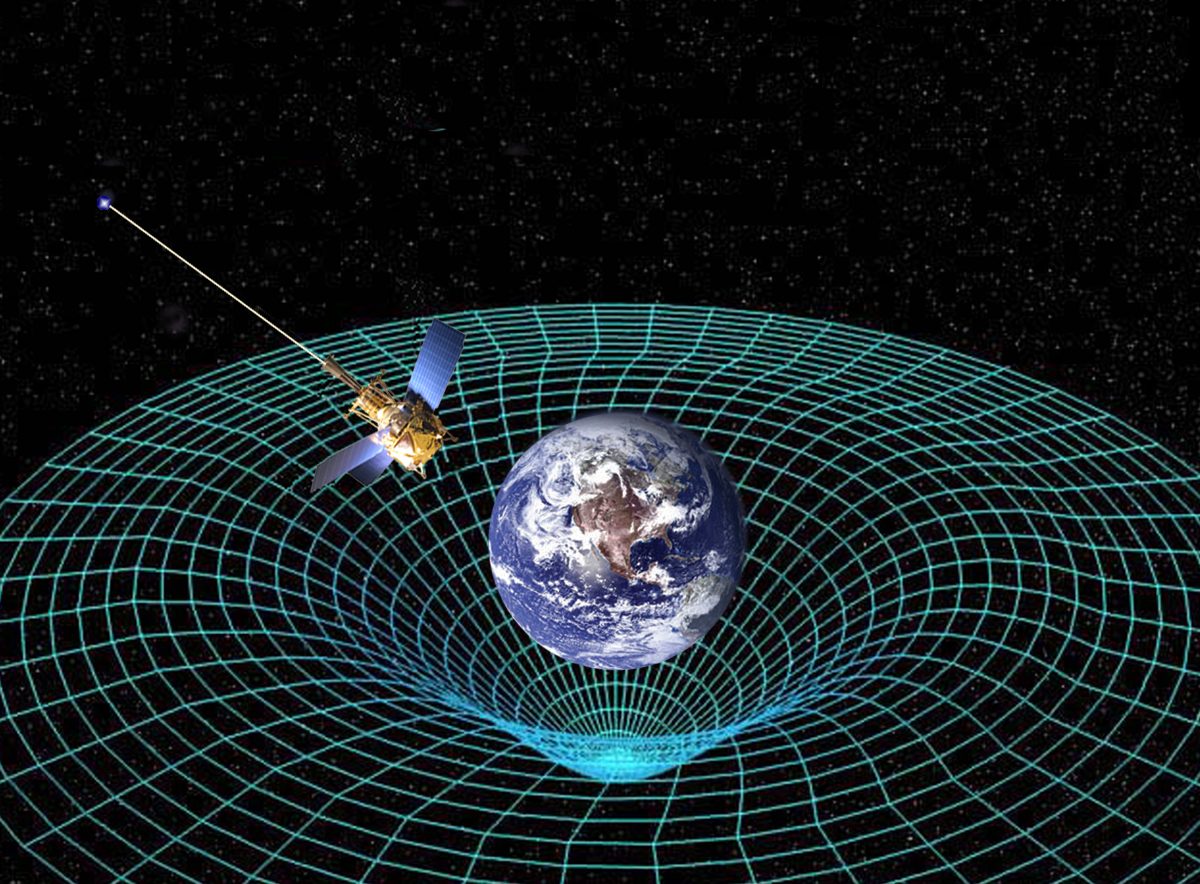 (NASA)
This is why people on board the International Space Station, which is further from Earth's gravity, age very slightly slower than those on Earth.
Is it possible to reverse time?
Of course, for us to actually see these effects on time, the change in speed or gravitational pull must be enormous. But as an observer accelerates towards the speed of light, unique measures of time become increasingly noticeable.
In theory, as a particle approaches the speed of light, we would see its 'clock' slow down. Once it exceeds the speed of light, its clock would, theoretically, seem in reverse from our point of view. From the particle's point of view, our clock would seem to reverse.
What about time travel?
Similarly, the space-contorting volume beyond the horizon of a black hole also distorts perspectives of time.
In our Universe, we have freedom of space and can move around as we like, but we're forced to march along time's arrow in a linear direction.
Calculations show that crossing over a black hole's horizon would swap those freedoms. So we'd no longer have to follow time's strict arrow of direction, but we'd lose the freedom to move around in space, allowing for time travel (of sorts).
While these scenarios help us better understand time's nature, both light speed and black hole travel have constraints that prevent us from using them as practical ways to reverse time.
Don't try either at home.
Why is there a future and a past?
Models of space-time can describe measurements of time and space varying from one point to the next, but they don't explain much about time's stubborn adherence to a sequence of events.
Under these descriptions of time, our Universe is a single block of space-time. There's sort of a beginning – the Big Bang – before which our best understanding of the laws of physics can't be applied. There's sort of an end, where change is no longer measured with any significance. But no single slice of time stands out physically as 'now'.
"People like us who believe in physics know that the distinction between past, present, and future is only a stubbornly persistent illusion," Einstein once wrote.
There might be a few clues to the mystery of time in fields of physics other than cosmology, though. For example, back in the 1870s the Austrian physicist Ludwig Boltzmann proposed there was a link between time and an increasing level of disorder in the Universe.
By tying thermodynamics' principle of entropy to time that only moves in one direction, it hinted at a possible explanation for why time's arrow points forward: perhaps our Universe moves from a low entropy, highly compact infant Universe, to a highly disordered, expansive Universe drifting into the future.
How to slow down time
Outside of taking a trip into space, and away from Earth's gravity well, there is a way to slow down time – at least from your own perspective. This has nothing to do with the physics and nature of time itself, but how fast or slow life feels to each of us.
Some researchers say that exposing yourself to new experiences or environments can actually make time seem to pass slower. This may be to do with the amount of information our brains have to take in and process – when we're young or learning something new, the world seems to slow down. As we get older and get into a routine, the days and years seem to speed by.
Unless you have a spacecraft, none of this is going to make you age any slower (sorry), but knowing that time is a little more bendy than many of us think it is can be a reminder that we have our own ability to alter our perception of how fast the days pass – if only a little.
All Explainers are determined by fact checkers to be correct and relevant at the time of publishing. Text and images may be altered, removed, or added to as an editorial decision to keep information current.
"time" - Google News
February 28, 2021 at 04:32AM
https://ift.tt/3ktfWts
What Is Time? - ScienceAlert
"time" - Google News
https://ift.tt/3f5iuuC
Subscribe to:
Posts (Atom)
Featured Post
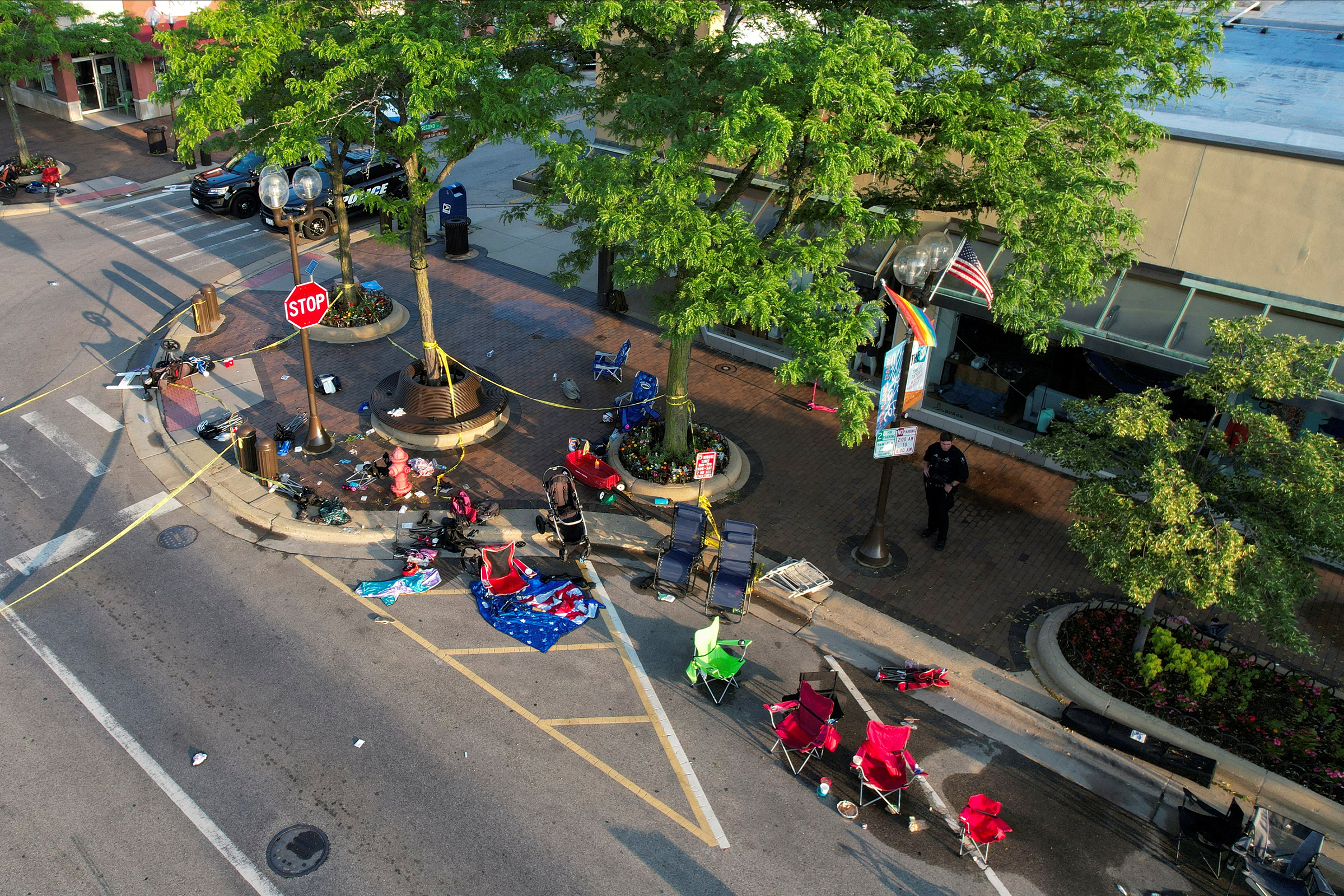
Highland Park Shooting: Latest Updates on Victims, Suspect | Time - TIME
lonk.indah.link T he gunman who opened fire on a Fourth of July parade in the Chicago suburb of Highland Park, Ill., seriously considered ...
Popular Posts
-
lonk.indah.link Enlarge Getty Images Microsoft is taking a lot of flak for planning to integrate a short-term financing app into the ...
-
lonk.indah.link On Wednesday, San Francisco lost another legend when performer and notorious local character Bambi Lake succumbed to cance...
-
lonk.indah.link T he gunman who opened fire on a Fourth of July parade in the Chicago suburb of Highland Park, Ill., seriously considered ...


