Rechercher dans ce blog

Tuesday, March 1, 2022

Biden State of the Union: Start time, how to watch and stream - The Philadelphia Inquirer

lonk.indah.link

President Joe Biden will deliver his first State of the Union address before Congress Tuesday as Russia continues its unprovoked invasion of Ukraine.

Normally a time for a president to focus on the domestic agenda, Biden’s speech is now expected to focus on the American response to Russian President Vladimir Putin’s aggression in Ukraine, which has claimed over 400 civilian lives and forced the evacuation of more than 500,000 people.

For the first time since the pandemic began, all members of Congress will gather in the House chamber for the annual event. Masks are no longer required, but it won’t be completely normal — the heavy metal security fence that surrounded the Capitol following the Jan. 6 insurrection is back up, and all invitees will have to produce a negative COVID-19 tests to enter the chamber.

Other topics you can expect Biden to touch on include rising inflation, his stalled Build Back Better legislation, and the economic gains of the past year. He’ll also likely take the opportunity to seek support for Supreme Court nominee Ketanji Brown Jackson, and tout the endorsement she received from retired federal judge and prominent conservative J. Michael Luttig.

ADVERTISEMENT

The address will air on all major broadcast networks and cable news channels to an expected audience of 35 million to 40 million viewers. It will also be streamed live online. Here’s what you need to know:

What time does Biden’s State of the Union start and end?

Biden is expected to begin his address live from the Capitol shortly after 9 p.m. It will air live on all broadcast networks and cable news channels, and is available to stream here on Inquirer.com, courtesy of PBS:

Over the past 10 years, State of the Union-style speeches have averaged one hour and seven minutes. Former President Barack Obama preferred shorter speeches that came in under an hour (his longest was 65 minutes in 2014), while all four of former President Donald Trump’s speeches to a joint session of Congress topped one hour.

Last year, Biden spoke for one hour and five minutes. But using the average length over the past 10 years, Biden’s address should end around 10:07 p.m. Eastern Standard Time.

Why is Biden’s State of the Union happening in March?

President Joe Biden, flanked by Vice President Kamala Harris (left) and Speaker of the House Nancy Pelosi during last year's address. . ... Read moreChip Somodevilla / MCT

Since the mid-1930s, most presidents delivered their annual State of the Union addresses in January. In fact, just five of the past 20 addresses dating back to 1997 have been delivered in February.

Biden’s speech will be the first State of the Union ever delivered in March and the latest scheduled since 1934, after Congress shifted the opening of its sessions to January.

ADVERTISEMENT

According to the Associated Press, the delay was driven by a busy legislative calendar, a winter spike in COVID-19 cases, and the 2022 Winter Olympics in Beijing, which tied up broadcast network time on NBC for much of February.

Who is delivering the Republican response?

Iowa Gov. Kim Reynolds will deliver the official Republican response to Biden's State of the Union address. . ... Read moreCharlie Neibergall / AP

Iowa Gov. Kim Reynolds will deliver Republicans’ rebuttal to Biden’s address.

Reynolds, 62, gained national attention from Republicans with her hands-off approach to the COVID-19 pandemic. She has opposed vaccine and mask mandates, was slow to impose restrictions, and the safety protocols her health department did impose were rolled back beginning in February 2021, before the delta and omicron waves.

“Iowa Governor Kim Reynolds represents what it means to lead with conviction and true faith in our fellow citizens,” House Minority Leader Kevin McCarthy said in a statement. “She handled COVID by choosing freedom over lockdowns and personal responsibility over mandates — leading to real economic recovery from the pandemic.”

The practice of delivering a televised rebuttal dates to 1966, when two Republicans — Sen. Everett Dirksen and then-Rep. Gerald Ford — offered a joint response five days after Democratic President Lyndon Johnson’s State of the Union speech.

Ford, who succeeded to the presidency in 1974 after President Richard Nixon resigned, would later become the first person to both deliver a response and a State of the Union address. Later, former Presidents George H. W. Bush and Bill Clinton also delivered rebuttals, as has Biden, who was part of the Democrats’ official response to Reagan while a senator in 1983 and 1984.

There will also be a Democrat responding to Biden’s speech

Rep. Rashida Tlaib (D., Mich.) said she'll deliver a speech supportive of Biden's agenda. . ... Read moreAndrew Harnik / AP

For the second straight year, a fellow Democrat will also deliver a formal response to Biden’s speech.

Rather than criticize Biden, Rep. Rashida Tlaib (D, Mich.), speaking on behalf of the left-wing Working Families Party, is expected to lay out a progressive vision for the next year and urge Democrats to deliver on Biden’s agenda.

ADVERTISEMENT

“Despite some sensational coverage, it’s simple: I’m giving a speech about supporting President Biden and his Build Back Better agenda for the people,” Tlaib tweeted last week. " Look past the headlines & hear progressives’ vision for working with the President & Congress to deliver for our residents.”

But don’t expect it to all be wine and roses, Tlaib, who gained notoriety for making a profane vow about former President Donald Trump, is expected to hammer moderate Democrats, who progressives view as stymying Biden’s economic and climate agenda.

How are the networks covering the speech?

ABC

  • Start time: 9 p.m.

  • Anchor: World News Tonight anchor David Muir.

  • Analysis: ABC News Live Prime anchor Linsey Davis, chief White House correspondent Cecilia Vega, chief Washington correspondent Jonathan Karl, This Week co-anchor Martha Raddatz, chief justice correspondent Pierre Thomas, senior White House correspondent Mary Bruce, congressional correspondent Rachel Scott, political director Rick Klein, and contributors Chris Christie and Donna Brazile.

  • Streaming: Live coverage on ABCNews.com.

  • Local affiliate: 6ABC (Channel 6)

CBS

  • Start time: 9 p.m.

  • Anchor: CBS Evening News anchor Norah O’Donnell.

  • Analysis: CBS This Morning co-host Gayle King, Face the Nation moderator Margaret Brennan, chief political analyst John Dickerson, and chief White House correspondent Nancy Cordes.

  • Streaming: Live coverage on CBSN starting at 8 p.m., anchored by senior White House correspondent Weijia Jiang, reporter Caitlin Huey-Burns, and CBS News Radio’s Steve Dorsey.

  • Local affiliate: CBS3 (Channel 3)

FOX

  • Start time: 9 p.m.

  • Anchor: Fox News America Reports anchor John Roberts.

  • Analysis: Fox News host Trey Gowdy and contributor Marie Harf.

  • Streaming: Live coverage on Fox29.com at 9 p.m.

  • Local affiliate: FOX 29 (Channel 29)

NBC

  • Start time: 9 p.m.

  • Anchors: NBC Nightly News anchor Lester Holt and TODAY co-anchor Savannah Guthrie.

  • Analysis: Meet the Press moderator Chuck Todd and senior Washington correspondent Andrea Mitchell.

  • Streaming: Live coverage on MSNBC.com at 8 p.m., NBCNews.com at 9 p.m., and on Peacock at 8 p.m. anchored by Zerlina Maxwell.

  • Local affiliate: NBC10 (Channel 10)

PBS

  • Start time: 9 p.m.

  • Anchor: PBS NewsHour anchor Judy Woodruff.

  • Analysis: Washington Post opinion writer Jonathan Capehart and New York Times and The Atlantic contributing writer Peter Wehner.

  • Streaming: Live coverage on PBS’s YouTube account.

  • Local affiliate: WHYY-TV (Channel 12)

How are the cable networks covering the speech?

C-SPAN

  • Start time: 8 p.m.

  • Anchors: C-SPAN host Greta Brawner and Peter Slen.

  • Analysis: Following the speech and the Democratic response, C-SPAN will take viewers’ phone calls and read opinions from Twitter and Facebook.

  • Streaming: Live coverage on C-SPAN.org.

CNBC

  • Start time: 8 p.m.

  • Anchors: The News with Shepard Smith anchor Shepard Smith.

  • Analysis: Kayla Tausche, CNBC senior congressional correspondent Ylan Mui, and CNBC anchor Andrew Ross Sorkin.

  • Streaming: Live coverage on CNBC.com

CNN

  • Start time: 8 p.m.

  • Anchors: Anderson Cooper 360 anchor Anderson Cooper and The Lead with Jake Tapper anchor Jake Tapper.

  • Analysis: CNN chief political correspondent Dana Bash, Inside Politics Sunday anchor Abby Phillip, CNN political director David Chalian, analysts David Axelrod, Laura Barrón López, Gloria Borger, and Evan Osnos, and commentators Scott Jennings and Van Jones.

  • Streaming: Live coverage on CNN.com and across mobile devices through the CNN app.

Fox News

  • Start time: 9 p.m.

  • Anchors: Special Report anchor and chief political anchor Bret Baier and The Story anchor Martha MacCallum

  • Analysis: America’s Newsroom co-anchor Dana Perino, senior political analyst Brit Hume, The Five rotating co-host Harold Ford Jr., and contributor Ben Domenech.

  • Streaming: Live coverage on FoxNews.com at 9 p.m.

MSNBC

  • Start time: 8 p.m.

  • Anchor: The Rachel Maddow Show host Rachel Maddow, The ReidOut host Joy Reid, and Deadline: White House host Nicolle Wallace.

  • Analysis: NBC News and MSNBC contributors Claire McCaskill, Michael Steele, Matthew Dowd, and Julián Castro.

  • Streaming: Live coverage on MSNBC.com

Adblock test (Why?)


"time" - Google News
March 01, 2022 at 07:01PM
https://ift.tt/rGM53jQ

Biden State of the Union: Start time, how to watch and stream - The Philadelphia Inquirer
"time" - Google News
https://ift.tt/QM2PhEa

Black History Month Is Over. What About the Black Future? | Time - TIME

lonk.indah.link

It’s 2072—a year that, like so many others that ultimately mattered, began in its own inconsequential way.

We find ourselves just four years shy of the United States’ third centennial. In the country born from promises of universal freedom but built on stolen land and labor, wealth has continued to be made accessible in patterns that track with race and ethnicity. Back in 2053, half of Black households reached the point of $0 wealth. And, next year, in 2073, half of Latino households will follow.

It is a reality rooted in rollbacks of social-inclusion measures and voting-rights protections—changes that took place even though, more than a decade ago, people of color became America’s supermajority, comprising nearly 60% of the entire population. White America has aged, and has shrunk in number and size, while other fast-growing demographic groups are still not served well by the economy or included without friction in American representative democracy. A substantial portion of the nation’s diverse workforce is poised to be replaced by robots. The small and nearly all-white billionaire class has the resources for joy rides beyond earth’s atmosphere, but hasn’t resolved a litany of major terrestrial social, civil, physical, and economic challenges.

As sea levels in places like Southeast Florida have risen nearly two feet upward on the measuring stick from where they were in 2019, white Americans have remained more likely to own homes and be made whole by insurance and government aid when disasters hit. Some Black Americans have found one potential silver lining in all those disparities: fewer economic and social ties to cut when the rising water forces a move. And, by 2072 they are already migrating—inward and upward. In the United States, it’s Denver; Santa Fe, N.M.; and Cody, Wyo.; cities at altitudes above 4,200 ft. that are filling with the people of color who are America’s first climate refugees. Soon, others will have no choice but to follow.

That’s the way it is. Unless. Unless, that is, we make a different future.

That unless was the most frequently repeated precaution I gleaned when, to mark the end of Black History Month, I asked experts to describe their visions of the Black future.

They are called futurists. Futurism is a multidisciplinary field whose practitioners use data and observation—as well as their imaginations and some might say hopes—to analyze what’s to come. Some of their predictions are a matter of numbers and facts; some are the stuff of sci-fi and philosophy. It’s a field to which government and corporate America has turned to set priorities, identify opportunities, and predict consumer interests.

“There is some stuff that I’m pessimistic about,” says Reynaldo Anderson, an influential Black futurist and Associate Professor of Africology and African American Studies at Temple University, “but I want to be wrong.”

Read more: How Black Lives Matter Is Changing What Students Learn During Black History Month

A brief summary of that stuff: white, minority rule of an allegedly democratic society; “that my people [are] going to drown and starve and be dislocated again and again by climate change”; widening inequality and segregation. “Change is happening faster than people’s ability to adapt to it,” he says. In fact, Anderson, who co-edited the book Afrofuturism 2.0 among others, says, we haven’t even tried. Our ethics and laws already sit decades behind what technology makes possible now.

As I spoke with 10 different futurists, there were, of course, a range of predictions. Those ran from deep concerns about the future of work and even the tax system that supports what we now consider civil society, to theories about the rising economic and cultural influence of China and portions of Africa where, by 2050, 25% of the world’s entire population is expected to live. Others expressed hope and faith in the ability of art to unlock human ingenuity; some were absolutely certain that people—particularly people of African descent—will soon reject systems that do not serve them, slipping the shackles of the oppressive concepts that today seem inescapable.


In fact, that reset may already be starting.

“You have the Great Resignation happening,” Ingrid LaFleur, a curator in Detroit, one-time mayoral candidate, and futurist says about the estimated 47.4 million people in the United States Department of Labor data indicates have resigned from their jobs since January 2021. “There are so many of us—meaning oppressed peoples—who have been given so many examples and have been encouraged to say no, you cannot extract this from me, and I’m excited to see what that means over time.”

In the not-so-distant future it will be normal for Black workers in the United States—the group that, contrary to stereotypes, federal labor data shows is the most likely to hold multiple jobs—to prioritize and elect joy, internal peace and rest, LaFleur thinks. It’s only logical, she says, that workers not well served by the current normal will be more receptive to different ways of working and living.

Another person who sees a wider range of possibilities for Black people in the future is the musician Camae Ayewa, better known as Moor Mother. Hers is one of the first names you’ll encounter if you start looking into ideas associated with the Black Future, such as Afrofuturism and the Black Speculative Arts Movement. They all combine ideas stemming from arts, science, technology and politics. She makes deep, poetry-driven music that’s haunting and rife with references to social conditions, quantum physics, philosophy, history, family, spirituality and health. When we speak by phone, she’s a few days into a three day artists’ residency in Padua, Italy. Soon she’ll leave for Paris for a similar gig. Back in the United States, her home, Moor Mother is also one of the founders of the Black Quantum Futures Collective, a Philadelphia-based group of artists, activists, and others.

“Our main theme of our work is time and temporality,” she explains. “The future is relative. So it’s about having agency in reclaiming that. You know, ‘reclaiming our time’ was a type of meme that went around a couple of years ago, and we really speak to this [idea], not just in the present.”

The collective’s work insists there is a place for Black people in the future. The group shares its ideas at workshops that introduce concepts from quantum physics to participants in low-income communities. Another workshop looks at superhero movies and asks attendees to notice how often characters of color are the ones dying early or outright missing. Another project maps and captures the stories of once-thriving all-Black towns that have disappeared, many of them as a result of racist mob violence. The goal is to help people imagine—and then create—a different kind of future.

“African people, Indigenous people have always thought about the future,” Moor Mother explains. “They looked to the stars. You know, it’s like a tradition that we have been cut off [from].”

Moor Mother’s predictions for the future include the possibility that Black people in the United States and around the world will reconnect with those ideas, exploring the work of African philosophers like the Kenyan scholar John Mbiti and novelists like Octavia Butler. In the future that exists in her mind’s eye, Black people will embrace the idea that time travel happens constantly in subtle ways. Slaves, who had and owned almost nothing, managed to leave small time capsules that in some places have been found beneath their cabins, Moor Mother says. When we grasp bits of our ancestors’ lives, we benefit from the wisdom they worked out. Consider, for example, the Afro pick: a tool created more than 5,000 years ago by people with experience with Black hair, and not coincidentally a symbol of self-acceptance in the present. And in our own work, we will leave messages for those who come after us.

Moor Mother of the Vijay Iyer Band performs at Prospect Park Bandshell on Aug. 14, 2021 in New York City.
John Lamparski—Getty Images

In the future, some of those messages may be in languages that are only just beginning to take shape. Anne Kyoya, a Black futurist in Nairobi and an emerging fellow with the U.S.-based Association of Professional Futurists, says she became a futurist because she sees it as a way for the African continent to focus on building the future that the people want. One of her more interesting predictions involves what’s known as “Sheng”: a hybrid of English and Swahili that has emerged among young people who need a common tongue after coming to Nairobi from rural areas where dozens of unofficial languages and dialects are spoken. Once regarded simply as slang, Sheng is today the language of survival and street commerce, of friendly exchanges and of those who are cool, Kyoya tells me when we talk over Zoom from her home outside the capitol. Kyoya predicts that in 20 years Sheng will be what some consider their first language or mother tongue, and will take its place in workplaces and organizations.

And it’s not just language that Africa’s young population will influence. More and more young people have studied or lived abroad, she says, and are bringing some of that back to their home countries. Already, some of the people who are most influential around the continent do not live in Africa at all, from Tanzanian millionaire businessman and environmentalist Patrick Ngowi to South African comedian Trevor Noah. Now the government structures just have to catch up—for example, reshaping tax codes to better accommodate the informal and gig work that supports many young people.

“What we are seeing is …what we call a global mindset,” she says. “Someone with a global mindset or a global entrepreneur is one who identifies problems that impact on society and then identifies the right partnerships to be able to attack that problem, irrespective of where they are stepping [live].”

When I ask Kyoya if it seems that the kind of economic and social trends she’s observing will, over the next 50 years, bring more frequent or deeper connections between people of the African diaspora scattered around the world, she laughs. Technology, in a way, makes the answer obvious. Kyoya quickly points out that she and I have never met in person but are speaking via Zoom, smiling at one another, taking in some of what there is to be known about one another.

Particularly now that the pandemic has untethered many people from their offices, both Kyoya and LeFleur see a coming world in which those realities, those cultural connections, position many Black people of various origins to engage in all kinds of joint social and economic projects. “We can not walk backwards to our future,” Kyoya says.


But even among futurists who disagree about the details, there’s a commonly held belief that if conditions do not change, the Black future, and thus the American future, may well have a bit of a dystopian movie feel. With one big change: while sci-fi has had a tendency to display a future world in which Black people either don’t exist or race itself ceases to have meaning, there are, to be very clear, Black people in the future.

Though, racial classifications in the United States have and are expected to evolve, the Black population in the United States—native and foreign-born—is expected to grow from about 49 million people, or 13.3% of the population in 2030, to 60.6 million people, or 15% of the population by 2060. And overseas, as much of the population in the West and China ages, Africa will be brimming with young people, and will see much of the world’s net population growth. In 2100, anywhere from 33% to 40% of the world’s entire population will be African—including an already burgeoning Afro-Chinese population that Yul Anderson, president of the African American Future Society, believes will help bring Chinese wealth to African nations.

But, Anderson says, anyone who reads that and assumes that a more multi-racial, less white, world will mean that racial inequality or discrimination will somehow cease to exist isn’t paying attention to the past, or for that matter, the present.

For example, one major international consulting firm is projecting that by 2030, automation will hit Black and Latino Americans harder than other groups because of the often low-wage industries in which those groups often work now. And thus far, the only “solutions” Anderson has heard many people talking about for the estimated 40% of Black workers expected to be displaced —that someone has to do the manual labor of maintaining all those robots, for example—do not sound serious or at all fresh, he says.

“If you are marginalized now, the potential is you are going to be marginalized in the future,” he says.

Read more: This Is How February Became Black History Month

This month, Anderson, who is Black and based in Atlanta—and whose claim to fame in the world of futurists includes a February 2020 prediction that conditions were ripe for mass social unrest in the United States—helped to organize The Future Black America conference for The International Monetary Fund and United Nations Educational, Scientific and Cultural Organization, better known as the IMF and UNESCO. He’s also working with Reynaldo Anderson, no relation, to help explore the possibility of creating a futurist certificate that schools could offer as an add-on to other degrees..

“If you don’t have a diverse group of people participating in the future direction of the planet then it just self-prophecies white supremacy,” says Yul Anderson. “Those in power predict and manipulate futures that keep them in power. So if you don’t get out there and say, ‘yo, hey, you got to make sure I’m in the future,’ then you are not going to be involved.”

The thing that gives Anderson some hope is the growing amount of power—to highlight injustices, to share ideas with people worldwide, to foment protest—that technology puts in the hands of many Black individuals. The events of recent years, following what Anderson calls the “Black Spring” of 2020, have both bolstered that idea and laid bare some of conditions that are necessary to see a better future come to fruition.

“I only hope that we can pivot as a people fast enough to change the trajectory of the negative reporting [forecasts],” he says. “It’s very difficult to talk about the future when you have a knee on your neck. The only thing you are thinking about is immediate relief.”

Anderson is less than optimistic elected officials—including the Black ones—are focused on the right fights to deliver a better future. But out of the UNESCO conference, work has begun to create a 200- to 300-member commission on the Study of the Future of Black America. The goal: produce reports that forecast the Black Future, spread the word about alternatives and what would be required to wind up there. The hope: that those ideas might wind their way into the work of elected officials or organizations that can help turn them into a reality.

Sun Ra Arkestra performs at Carnegie Hall's Zankel Hall on Feb. 17, 2022
Lawrence Sumulong

Black people around the world, given their struggles in the present, have a particular need to develop and “flex” their foresight muscles, Anne Kyoya told me when we spoke. That’s an idea very much on my mind when I walk into Carnegie Hall in late February for a Sun Ra Arkestra concert, part of an Afrofuturism festival. Reynaldo Anderson, the Temple professor, is a member of the Curatorial Council that helped plan the event.

I’m here because the late Herman Blount, better known as Sun Ra, a mystical, avant-garde Black American musician and poet who made racial metaphor of extraterrestrial origin stories, remains a guidestar in this realm, even nearly 30 years after his death. His group’s art is a core part of the soundtrack preferred by many who work at, enjoy or try to think hard about the Black Future.

Inside, the audience is a little less than half Black. And among them are an unusual number of gray-haired Black men in black berets. Band leader Marshall Allen, 97, plays a saxophone solo like he has the lungs of a man a third his age. Behind him is the nearly 30-piece Arkestra—dressed in sequin-covered capes, baseball caps, Breton hats, Fez, and Kufi—and two singers with voices that make this fact-focused reporter feel, in a word, transported.

The songs are jazzy, some more improvisational than others. But the lyrics, the sounds, the on-stage caped dancer, evoke a kind of feeling of time travel—backwards and forwards. A white woman in the audience pulls a tambourine from her purse. Then, Moor Mother comes to the front of the stage and speaks a poem over the Arkestra’s sounds.

“I was never here,” she says slowly, speaking of the past, the present and the Black Future. “Just a continual echo in a strange land. I was a quantum event on this planet, desolate and dangerous…..From 1619…whose timeline? Whose life is this?”

More Must-Read Stories From TIME

Adblock test (Why?)


"time" - Google News
March 01, 2022 at 07:00PM
https://ift.tt/Gezp0D8

Black History Month Is Over. What About the Black Future? | Time - TIME
"time" - Google News
https://ift.tt/QM2PhEa

Featured Post

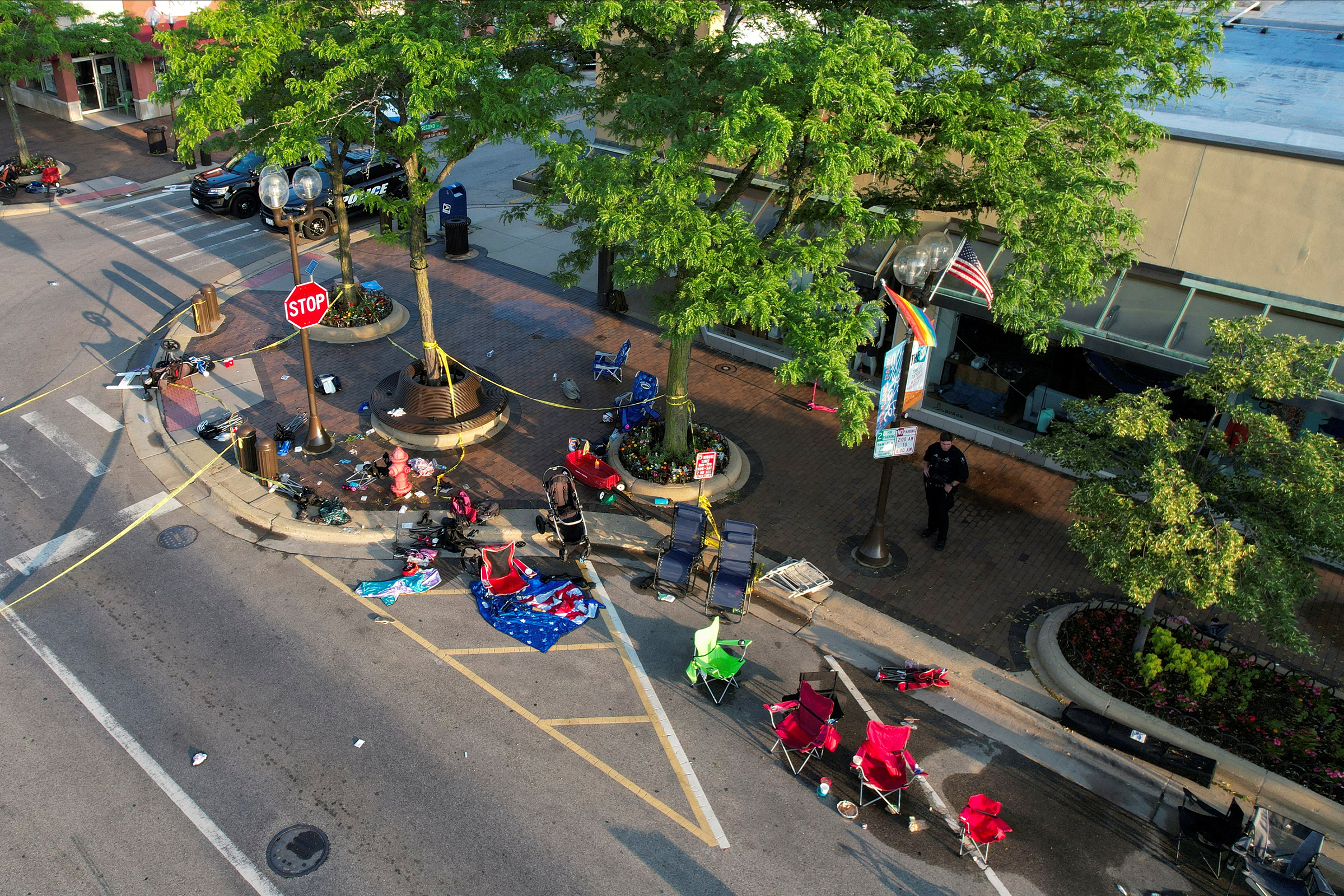
Highland Park Shooting: Latest Updates on Victims, Suspect | Time - TIME

lonk.indah.link T he gunman who opened fire on a Fourth of July parade in the Chicago suburb of Highland Park, Ill., seriously considered ...

Popular Posts